
MT-404 DRONE RF PROTECTION
This briefing illustrates how the MT-404 multilayer coating interacts with external radar and RF signals on a drone (unmanned aerial system).
It also explains the realistic contribution the technology can make toward reducing the vulnerability of the aircraft to external RF interference and unauthorized signal injection attempts.
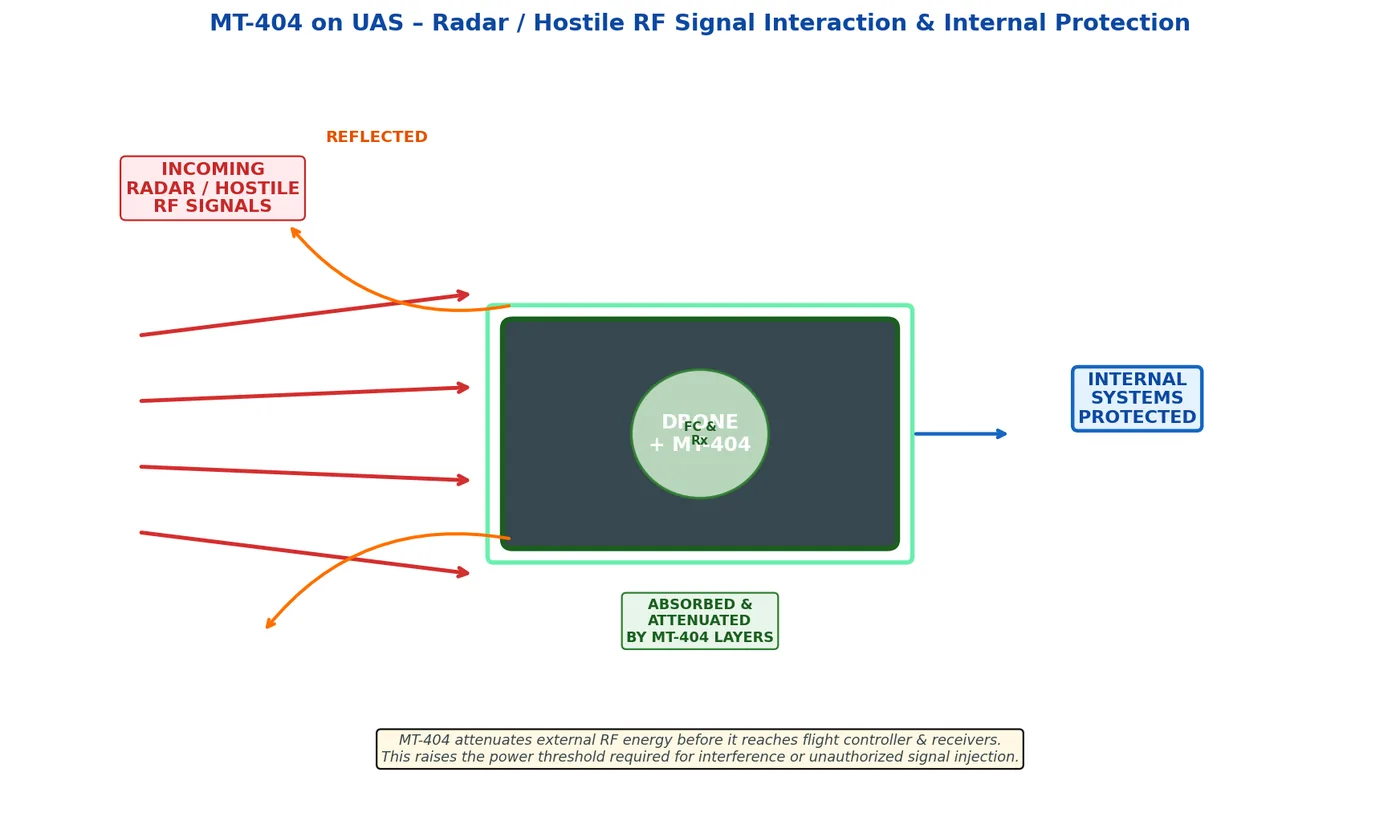
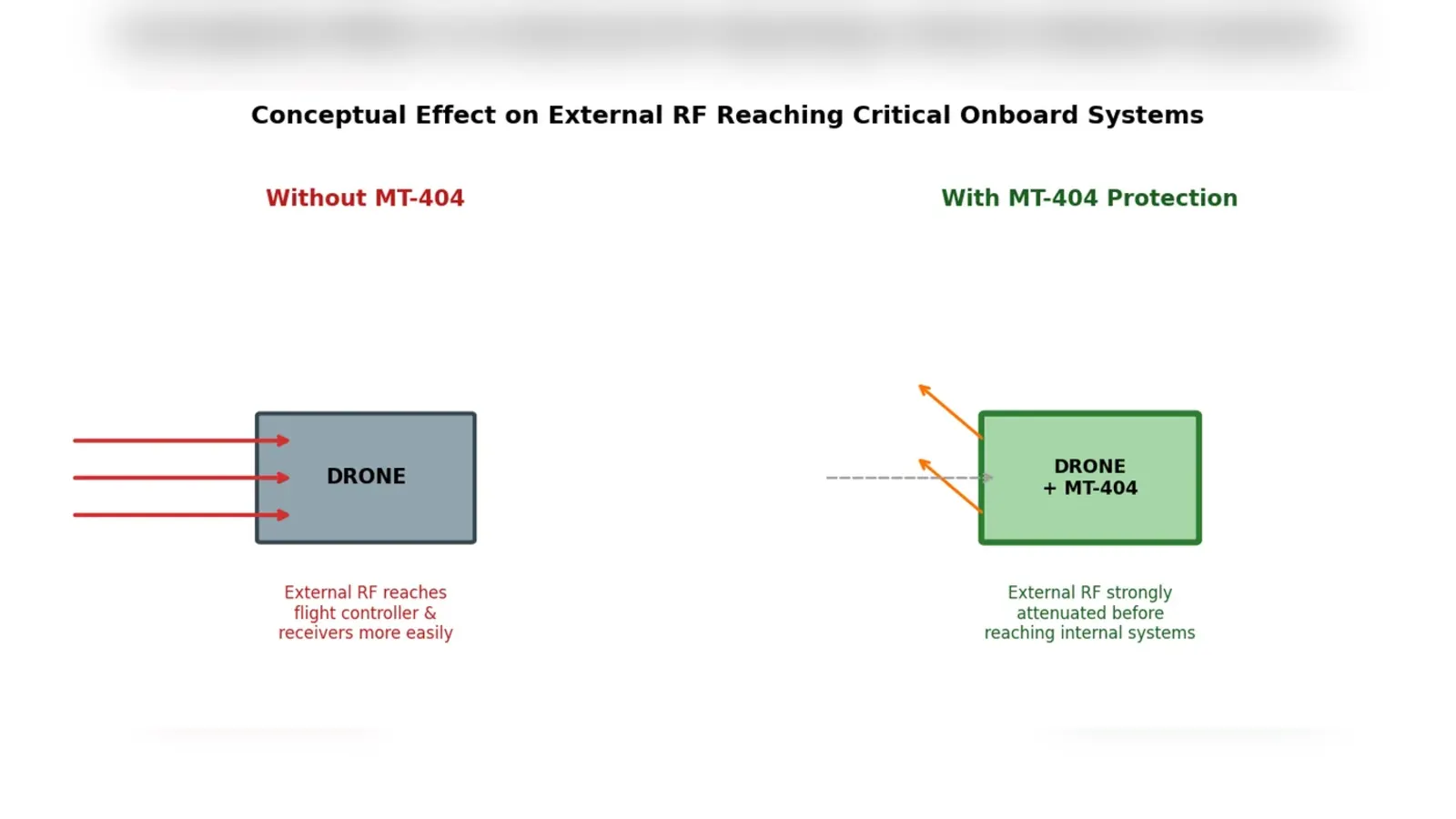
RADAR AND HOSTILE RF SIGNAL INTERACTION
When external radar energy or other RF signals strike a drone treated with MT-404, a portion of the energy is reflected at the outer interfaces and a substantial portion is absorbed within the functional layers. The residual energy that reaches the interior is strongly attenuated.
Without protection, external RF reaches internal systems more readily. With MT-404, the same external signals are strongly attenuated before they can interact with the flight controller and radio receivers.
RESISTANCE TO RF-BASED INTERFERENCE
Many unauthorized control or disruption scenarios against drones rely on radio-frequency means: jamming, spoofing or injection of commands on the control, telemetry or video links. These attacks require the hostile signal to reach the drone receivers and flight controller at sufficient strength.
MT-404, when properly applied around the avionics and receiver compartments (or as a selective exterior treatment), raises the power level that an external transmitter must produce in order for its signal to arrive at the internal electronics with usable strength.
-
Jamming and spoofing:
Low-to-moderate power attempts originating from a distance are more likely to fall below the detection or demodulation threshold of the protected receivers. -
Physical attenuation layer:
Complements, but does not replace, cryptographic authentication, frequency agility and proper link design. -
Legitimate links:
Control links must still be engineered with adequate link margin or designated RF windows so authorized signals remain usable.
PRACTICAL GUIDANCE FOR DRONE INTEGRATION
-
Interior application:
Apply MT-404 preferentially around flight-controller and receiver enclosures for maximum protection of critical electronics with minimal aerodynamic impact. -
RF windows:
Maintain clear apertures for the drone command, telemetry, GNSS and video antennas so authorized links remain reliable. -
Validation:
Validate both the attenuation of unwanted external signals and the preservation of required own-link performance through laboratory and flight testing. -
Layered security:
Treat the coating as one layer in a multi-layer security approach that also includes cryptographic and procedural controls.
SUMMARY
When a radar or other external RF signal strikes a drone protected by MT-404, a significant fraction of the energy is reflected or absorbed before it can reach the internal flight controller and radio receivers. This attenuation raises the difficulty of RF-based interference and unauthorized signal-injection attempts.
MT-404 is a passive electromagnetic attenuation material. It is not by itself a complete anti-hijacking or cybersecurity solution and should be used together with, not instead of, strong cryptographic and operational security measures.
Disclaimer: This briefing is for technical evaluation. Illustrations are conceptual. Actual attenuation depends on coating thickness, coverage, frequency and installation quality. MT-404 does not guarantee immunity from hacking or loss of control; it reduces the effectiveness of RF energy reaching protected electronics.
Contact
Enquiry form
Tell us about your environment and our team will recommend the right coating.